
Boundary County Crime News
Start with the Bonners Ferry Herald public-records hub. The Herald groups its Boundary County Court Records by publication and date window. One weekly installment covered August 1–7, 2026. It went to print on August 13, 2026. So the paper publishes court records after booking, not a same-day jail feed.
The Herald also runs event-driven crime stories involving the Boundary County Sheriff's Office and Bonners Ferry Police. Some of those pieces credit a booking photograph to BCSO or BFPD. That is occasional narrative reporting, though, not a county photo list. An article may say someone was held at Boundary County Jail on its publication date. But that wording tells you nothing about custody later on.
NewsBF supplies the long historical trail. Its archive holds older sheriff logs, court dispositions, and local news pages reaching back to the 2010s. The Bonner County Daily Bee adds broader regional coverage that sometimes touches Boundary County, Bonners Ferry, and Moyie Springs. Both are strong for context. Just keep the publication date attached to anything you take from them.
A news story is not a case outcome. Before repeating what a newspaper, arrest photo, or sheriff quote says, check iCourt for the actual case record.
Boundary County News Outlets
Each outlet answers a different question. Official agency sources lead the list. They name the arresting office and use its own status language. Local publishers add publication context on top of that, while private aggregators stay secondary and inconsistent.
| Outlet or source | Coverage | Photos? | Where it fits |
|---|---|---|---|
| Boundary County Sheriff’s Office | Official county news, alerts, and public information | Current home says no pictures published | Start here for agency language and a records contact. |
| Bonners Ferry Herald | Weekly court-record windows and event-driven county crime stories | Occasional article photos credited to BCSO or BFPD | Use the records hub and date each story. |
| NewsBF | Historical sheriff logs and court dispositions | No current gallery located | Useful for archival research; not current custody. |
| Bonner County Daily Bee | Regional stories crossing Boundary and Bonner counties | Varies by story | Read as article-date reporting, not a county roster. |
| Bonners Ferry Police | Municipal agency news and records route | No public city feed found | Request a city incident or arrest record. |
| Mugshots.com | Historical Boundary County index observed around 2012–2019 | Third-party images may appear | Unofficial and stale; do not treat as current or authoritative. |
| RecentlyBooked, Busted Newspaper, Arrests.org, Mugshots.zone | Selected Idaho counties or network routes | Not verified for current Boundary coverage | Boundary was absent or no local route was established during review. |
Private local-index sites appear here only to explain search results. They are never endorsements. Their coverage, source data, correction rules, and dates all shift over time. A local news summary has no place for a face grid or copied third-party records.
What the Herald Publishes
The Herald maintains a public-records index drawn from court filings. It is the clearest local window on publication dates. It never promises a full jail roster, though. A court entry is an after-booking record. Case details can appear there that a crime story never mentions.
Event coverage in the paper leans on agency bylines like BCSO and Bonners Ferry Police. One 2020 Herald story credited BCSO for a booking photo. It also said the subject was held at Boundary County Jail. Stories from 2021 likewise credited images to BCSO or BFPD. So the paper publishes photos case by case. The source is always the agency involved. That is not a daily mugshot policy.
Need a correction? Contact both the publisher and the agency that supplied the image. Include the article URL, the source date, and any court paperwork you have. An old photo says nothing about who is in custody now. The publisher's copy is no stand-in for an official booking record.
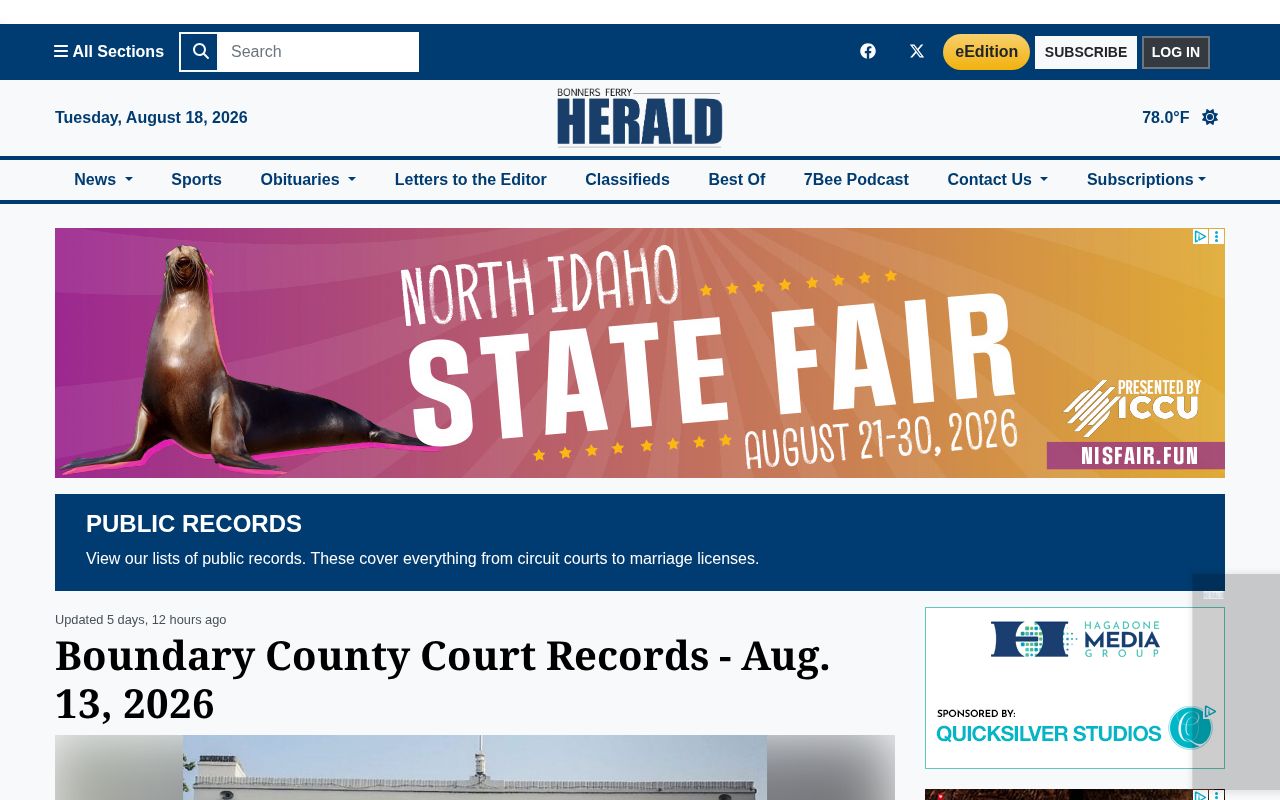
The Herald hub shows a public-records page with date-window context. It stops short of a complete booking roster.
NewsBF and Regional Archives
NewsBF's archive index keeps older local pages alive, including sheriff logs and court-disposition material. The site says its pages stay online as long as the site runs. That is a publisher-persistence note, not a government retention schedule. A 2017 page still loading today carries a historical, released-or-unknown custody label.
The Bonner County Daily Bee handles stories that cross county or agency lines. Examples include a May 2026 manhunt, a June 2026 case tied to Moyie Springs, and a June 2026 clarification involving IDOC and an immigration detainer. Each report belongs to its publication date. Some carry no booking photograph at all. None of them should be treated as a current inmate result.
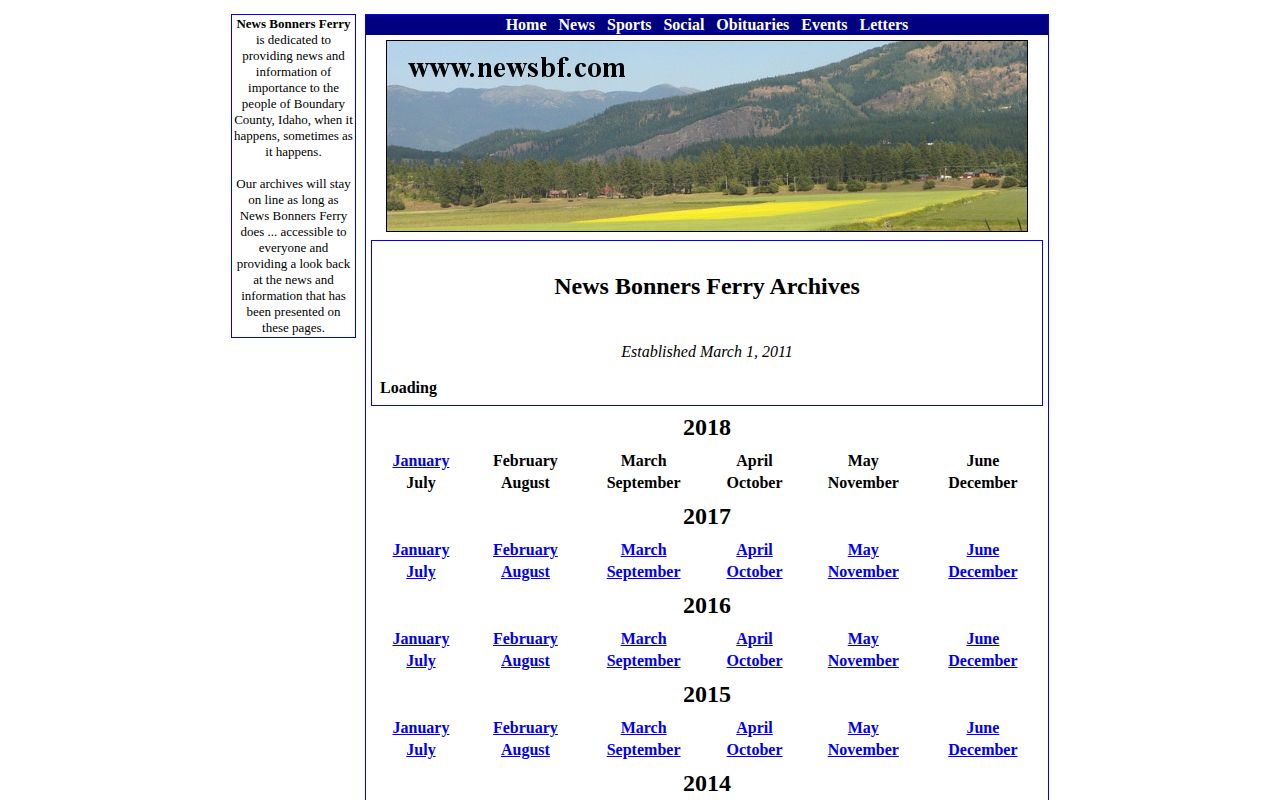
NewsBF documents a historical archive route. Use it for older logs and dispositions, not current custody questions.
The Daily Bee represents regional reporting. Any summary of its work must keep the article date and agency wording attached.
How Boundary County Photos Reach News
Idaho law tells county jails to photograph everyone booked in. Yet nothing in that statute forces a public gallery. So where do Boundary County photos come from? The sheriff's own site publishes none. A news outlet can still run one when an agency hands it over or when the publisher obtains a releasable record. The credit line usually reads BCSO or Bonners Ferry Police. The honest article names both the source and the date it ran.
Whether an agency hands over a photo at all hinges on several things. Investigative status matters. So do privacy, juvenile protections, officer safety, and whatever the public-records law currently allows. Idaho Code §74-124 lets an agency hold back an investigative record when release would hamper enforcement, tip a fair trial, expose a source or technique, or endanger someone. Ask for one booking event, not the county's whole photo file.
If a story shows an image, treat it as that outlet's presentation. The underlying record may later be corrected, sealed, or resolved in court. Don't copy or rehost the picture. Link the story instead. Note who published the photo, and keep an eye on what the court eventually does.
From a Story to the Record
A news story is only the trailhead. The records behind it may live with different custodians, and they rarely share the same dates, so expect some legwork between the headline and the actual file.
- Save the article title, publication date, named agency, alleged charge, and any statement about the facility.
- Check the county-wide roster and booking path. Boundary currently exposes no public roster, so note the absence rather than substituting an aggregator.
- For a Bonners Ferry event, ask the police records custodian for the incident or arrest record. For a county event, ask BCSO for the specified booking record or photo.
- Search iCourt by party name or case number. A sealed or restricted case may not appear.
- Read the later disposition. A charge can be reduced or dismissed, and an article’s arrest wording may never be updated.
Why separate the dates? A booking date, an article's publication date, a court date, and a release notice each mark a different milestone. Today's article can describe an arrest from weeks ago. A court item published this week may concern a case filed long before it. A VINE notice can arrive after the story ran, telling you about a release the paper never mentioned.
Boundary County’s After-Booking Timeline
How does a Boundary County arrest move from booking to outcome? The district court and its iCourt portal form the bridge. The typical path runs from arrest to initial appearance, then a complaint or citation, bond conditions, further hearings, and finally disposition. Remember that an arraignment is an early stop. It is not the destination.
When a case is public and indexed, iCourt can show the case number, parties, filings, hearing history, and outcome. Some files are sealed or restricted, though. The court record won't always tell you where a person is held. The jail record won't reveal how the case ended.
VINE, where it's integrated, sends enrolled release and court notifications. It is not a news archive, a warrant check, or a place to find photos. A private aggregator may keep an old image around long after the court has moved on. Corrections have to go separately to the agency, the court, the publisher, and the platform hosting the image.
Boundary County Crime Data
For hard numbers, the official 2024 Boundary County NIBRS report gives a measured local picture. It counts 204 Group A offenses. Sixty were cleared. The same category shows 32 adult and 2 juvenile arrests. Group B adds 42 adult and 4 juvenile. Drug and narcotic violations stand at 48 reported, 26 cleared, and 19 adult plus 1 juvenile arrest, while DUI shows 23 adult and 1 juvenile.
Read those figures carefully. They come from agency-level NIBRS reporting. They are not jail admissions, unique individuals, booking photos, or the current inmate list. One incident can carry several offenses. The report aggregates what agencies reported rather than tracking a single jail's intake, so keep the year and category labels attached to any use of the numbers.
That distinction matters when a headline or private page treats an arrest total as a mugshot count. It isn't one. A trend report can describe law-enforcement data. The booking record, the court file, and custody status stay three separate things.
Bonners Ferry and Moyie Springs News
Bonners Ferry coverage draws on a genuinely municipal source. The city runs its own police department, with a Police Public Records Request form. Still, stories from the county seat can involve BCSO, Idaho State Police, tribal authorities, Border Patrol, or the Forest Service. Name the arresting agency and the booking destination separately; they aren't always the same.
Moyie Springs coverage is different. No city police department exists there. Everything routes through the county sheriff. The Herald and the regional Daily Bee may report on a Moyie event, but neither offers a continuous city booking feed, and a third-party site slapping a city label on a record doesn't change that structure.
The two cities take different enforcement routes. Yet both land in the same county courts and jail. Trace a local story to the agency record, then to iCourt, rather than searching as though every city keeps its own roster.
Follow the Disposition
A booking photo grabs attention. The court record changes quietly in the background. Charges get reduced, dismissed, or resolved by plea or trial. An arrest article can be fully accurate on the day it runs and incomplete a month later. The honest label for a source is something precise, such as "arrest event," "case pending," "disposition," "released," or "historical," rather than a sweeping conclusion about the person.
When the official result is missing, say exactly that. A blank iCourt result may mean sealing, restriction, delay, or simply a bad search. A missing roster entry may mean there is no public roster, or that the person was released, transferred, or held elsewhere. That uncertainty belongs in the record summary itself.